Plaster vs Drywall in Prewar NYC Homes: How to Tell, Repair or Replace
Plaster vs drywall in prewar NYC apartments and houses: how to tell which you have, why plaster cracks, how to repair it, lead rules and typical NYC costs.
- By
- DecoStyle USA
- Published
- Reading time
- 11 min
In this guide
Plaster vs drywall comes down to this: plaster is harder, denser and quieter, while drywall is cheaper, faster to install and easier to patch. If you live in a prewar NYC apartment or an older Brooklyn or Queens house, your walls are most likely plaster unless a renovation replaced them: plaster was the wall finish in nearly all American buildings until the 1930s or '40s. Cracked plaster walls are usually worth repairing, not tearing out.
In NYC, plaster wall repair typically costs $300–$900 for hairline cracks and small patches in one room, $500–$1,500 per area for loose or broken plaster, and $2.50–$6 per sq ft for a skim coat. Those are typical market ranges, not DecoStyle quotes: we price plaster repair in NYC after a free site visit.
How to tell if your walls are plaster or drywall
Try these in two or three rooms: many prewar apartments are a patchwork, with drywall in a renovated kitchen or bath and plaster everywhere else.
- Building age. A building from before about 1940 almost certainly started out with plaster. Drywall became the norm in the mid-20th century, so the 1940s and '50s can go either way.
- Knock. Plaster sounds dull and solid almost everywhere; drywall sounds hollow between the studs. A patch of plaster that sounds hollow or gives when pressed may have come loose from its lath.
- Thumbtack. Inside a closet, push a thumbtack in with your thumb. It sinks into drywall; plaster is too hard to take it.
- The edge at an outlet. Switch off the breaker, remove the cover plate and look at the wall's cut edge around the box, without touching the wiring. Drywall is one paper-faced layer of gypsum, usually 1/2 or 5/8 inch. Plaster is thicker and layered, with wood strips, metal mesh, masonry or a paper-faced gypsum panel behind it; on wood lath it should be at least about 3/4 inch.
| When the wall went up | What is usually behind the paint |
|---|---|
| Before about 1900 (the brownstone era) | Lime plaster, often with animal hair, on wood lath or straight on brick |
| About 1900 to the 1930s | Gypsum plaster, often with a lime finish coat, on wood or metal lath, brick, hollow clay tile or gypsum block |
| Late 1930s to the 1950s | Plaster over rock lath (paper-faced gypsum panels), or early drywall |
| Mid-20th century on | Drywall, sometimes veneer plaster |
| Any age, after a renovation | A mix of both |
Free estimate
Want a quote for this?
DecoStyle USA does plaster repair across NYC and Long Island. Free site visit, written quote.
Plaster Repair in NYCHow plaster and drywall walls are built
Lath and plaster
Wood lath is narrow strips nailed across the studs with gaps between them. Wet plaster pushed through the gaps hardens behind the strips into keys, the hooks that hold the wall on. Expanded metal lath, in use by the late 19th century, grips better. The best work went on in three coats: scratch and brown coats of about 3/8 inch each, then a white finish coat about 1/8 inch thick.
Plaster on masonry
Lime plaster was often troweled straight onto brick. In early 20th-century masonry buildings, the walls between rooms may be hollow clay tile, ribbed or scored to take plaster, or gypsum block. Plaster on masonry suffers when the wall behind it stays wet.
Lime vs gypsum plaster
Until the early 1900s, plasterers used lime plaster: lime, sand, water and cattle or hog hair, which could take over a year to dry. Around 1900 gypsum came into use; it sets in minutes and dries in two to three weeks. Once cured the two are hard to tell apart, but gypsum is more vulnerable to water.
Rock lath
Paper-faced gypsum panels under a base coat and a finish coat of plaster; by the late 1930s it was used almost exclusively in residential plastering. From an attic it looks like drywall, but the room side is hard plaster.
Veneer plaster
Gypsum panels with a special face paper (blueboard), joints meshed, then one or two coats of high-strength plaster about 1/16 inch thick. The National Park Service's Preservation Brief 21 says it costs less than two- or three-coat plaster, only slightly more than drywall, and looks more like traditional plaster than drywall does.
Drywall
A paper-faced gypsum core (Sheetrock is USG's brand name) screwed to studs in sheets, most often 1/2 or 5/8 inch thick, with joints taped and finished in joint compound. Gloss paint or strong raking light calls for a Level 5 skim coat over the whole board. Fire-rated Type X board has glass fibers in its core.
Plaster vs drywall: pros and cons
| Item | Plaster (three-coat, on lath or masonry) | Drywall |
|---|---|---|
| Sound | Thick and dense; reduces sound transmission | A basic stud wall passes more sound unless built up with extra layers and insulation |
| Fire | Resists fire well | Gypsum core resists fire; Type X board is made for fire-rated walls |
| Durability | Very hard surface; cracks when the building moves | Dents and gouges more easily; seams and screws can pop |
| Cost to repair (typical NYC) | $300–$900 for cracks in a room; $500–$1,500 per loose or broken area | $200–$450 for small holes; $300–$700 per larger patch |
| Cost to replace | New plaster in a section: $12–$25 per sq ft | Cheaper and faster to hang; veneer plaster costs only slightly more |
| Mess | Tearing it out is heavy, dusty demolition | Hanging board is clean; sanding compound makes fine dust |
| Surface | Hand-troweled, often gently wavy | Flat; seams can show under gloss paint and raking light |
The practical rule: keep plaster where it is sound, and use drywall where walls are being built or gutted anyway. Replacing plaster in an occupied apartment means demolition dust, debris down the service elevator and, in a co-op or condo, the board's alteration rules. And because plaster is thicker than drywall, new board has to be furred out, or door and window casings end up standing proud of the wall.
Why plaster walls crack in NYC buildings
The pattern points to the cause, and the cause decides the repair:
- Diagonal cracks from the corners of doors and windows: stress and settlement, or an old renovation that cut a doorway without a proper header.
- Horizontal cracks that return every year: wood lath swelling and shrinking with humidity. NYC's heat season runs October 1 to May 31, and steam heat dries the air for months before humid summers swing it back.
- Straight cracks in a house from the late 1930s on: possibly the seams between rock lath panels opening.
- Cracks near a train line or heavy traffic: vibration mimics settlement; in New York, think elevated subway lines or construction next door.
- Fine, random map cracking: a fault in the thin finish coat.
- Bubbling, powdery or stained plaster: water from a leak upstairs, a radiator, the roof, or damp masonry pushing salts out as white efflorescence. Stop the water first, because repairs on a wet base fail again.
- Bulges and sagging ceilings: the keys have broken. Plaster that isn't reattached eventually falls in chunks, so keep people out from under it.
- A crack that keeps widening: call a structural engineer before a plasterer.
How to repair plaster walls
Hairline cracks
If the plaster around them is firm, fill with all-purpose joint compound, sand lightly, spot-prime and paint.
Cracks that keep reopening
- Widen the crack slightly with a pointed tool and brush out the dust.
- Fill it with quick-setting joint compound and press fiberglass mesh tape into it. Setting compound hardens by chemical reaction and shrinks less than ready-mixed, but it is hard to sand.
- Once set, cover the tape with a second coat feathered wide at the edges.
- Finish with a thin coat of all-purpose compound, sand lightly, wipe with a damp sponge, prime and paint.
Loose or bulging plaster: plaster washers
Where plaster has pulled away from its lath but the wall around it is sound, it is screwed back tight with plaster washers, thin metal washers on screws driven into the lath, then taped and skimmed over. Do loose ceilings first: they are the ones that fall.
Holes down to the lath
Holes under about 4 inches are filled in two applications, base coat then finish coat; a one-coat fill tends to dry concave. For larger holes, the plasterer clears loose plaster, re-nails the lath, applies a bonding agent, fastens expanded metal lath over the wood lath and builds up three coats, each stepped over the old plaster.
Skim coating over cracked plaster
When a wall has more cracks and patches than sound surface, a skim coat resurfaces it: two or three thin coats of compound or plaster over the whole wall, sanded or troweled flat. Loose plaster is re-secured and cracks meshed first, and glossy paint gets a bonding primer (read the lead rules below before sanding anything). On a wall crazed all over, fiberglass mesh can be bedded across the whole surface. Skim coating is also the prep for gloss paint, deep colors, wallpaper and Venetian plaster.
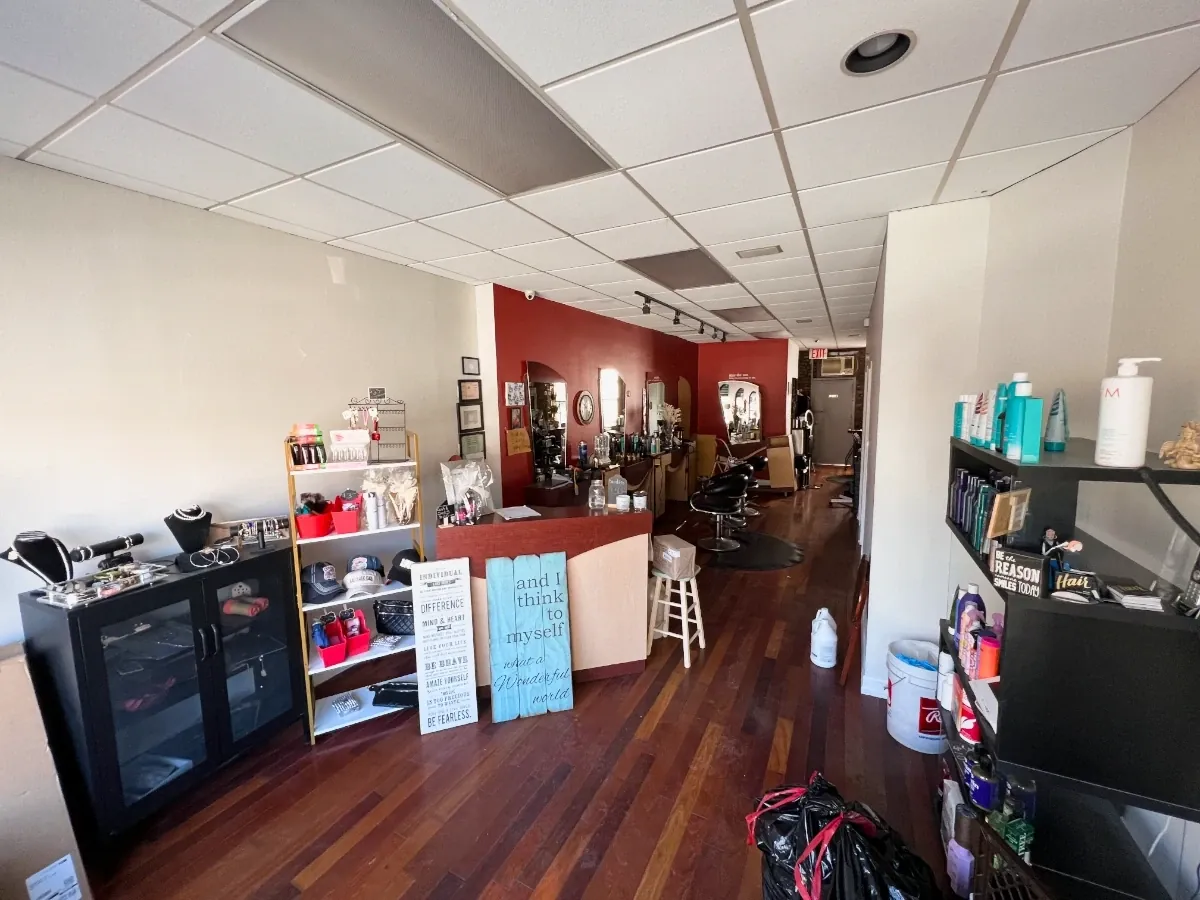
Salon Deana in Astoria before the work: years of fixtures had left the walls holed and patched, and the deep red needed primer before a lighter color would cover it.
Every repair is primed before paint, or the patches show through. New plaster needs two to three weeks to cure, then an alkali-resistant primer. At Salon Deana in Astoria, a job that included plaster repair, we patched and skim-coated the damaged wall sections, sanded them flat and primed over the old red and tan before the new color.
When to cover plaster with drywall, or tear it out
When plaster is crumbling, rotted by long-term leaks or loose across most of a surface:
- Cover it: thin 1/4- or 3/8-inch drywall screwed through the old plaster into the studs, with outlet boxes extended and trim reset. A sagging but dry ceiling can stay up too: furring strips are screwed through it into the joists and a new surface built on them, with much less dust than demolition.
- Replace a section: match the old wall's thickness so trim and patch lines don't show. Veneer plaster on blueboard is the closest match; drywall works shimmed out flush.
- Tear it out: the dust can carry decades of soot, lead from old paint and, in some mid-20th-century plaster, asbestos, which the EPA says you generally can't identify by looking. Have suspect plaster sampled by an accredited professional, and in a co-op or condo, check your alteration agreement first.
Lead paint: check before you sand or scrape old plaster
NYC's housing agency, HPD, presumes that residential buildings built before 1978 contain some lead-based paint. Sanding fresh joint compound is not the risk; scraping, deglossing and cutting out old painted plaster are.
- Hiring someone. Under the EPA's Renovation, Repair and Painting rule, paid work that disturbs more than six square feet of paint per room inside a home built before 1978, and any demolition of painted surfaces, must be done by an EPA-certified firm using lead-safe practices. Open-flame burning is banned, power sanding needs a shroud and HEPA vacuum attachment, and heat guns must stay below 1,100°F.
- Doing it yourself. The rule generally doesn't apply to homeowners working in their own home (it does if you rent out all or part of it), but the EPA still urges lead-safe DIY practices: find out whether lead is present, contain the area, protect yourself, keep dust down and clean thoroughly.
- Rentals in NYC. Local Law 1 adds landlord duties in buildings built before 1960 (or up to 1978 if the owner knows there is lead paint), especially where a child under six lives or routinely spends 10 or more hours a week, including in co-op and condo units the owner doesn't live in. For repairs disturbing 2 square feet or more of paint in a room, HPD's safe work practices call for EPA-certified firms, no dry scraping, plastic sheeting, daily mopping and HEPA vacuuming, and dust-wipe testing by certified workers independent of the contractor before anyone moves back in.
Plaster repair is not lead abatement, a separately certified trade. When you ask for an estimate, give the building's age, say whether young children live there and ask how dust will be contained.
Plaster wall repair cost in NYC, compared with drywall repair
| Repair | Typical NYC range |
|---|---|
| Plaster: hairline cracks and small patches, one room | $300–$900 |
| Plaster: loose, bulging or broken section | $500–$1,500 per area |
| Plaster or drywall: water-damaged section, after the leak is fixed | $550–$1,600 |
| Skim coat over plaster, walls or ceilings | $2.50–$6 per sq ft |
| Skim coat a bedroom (about 10 × 12 ft), walls and ceiling | $1,200–$3,200 |
| New plaster in a section (three-coat or veneer plaster) | $12–$25 per sq ft |
| Drywall: small holes, dents and nail pops, one visit | $200–$450 |
| Drywall: larger patch, up to about 2 × 2 ft | $300–$700 per patch |
| Drywall: several repairs across an apartment | $400–$1,250 |
| Level 5 skim coat over drywall | $1.50–$3.50 per sq ft |
Typical NYC market ranges, reviewed November 2026; not DecoStyle quotes.
How much does it cost to plaster a 10 × 10 room? With an 8 ft ceiling, the walls come to about 285 sq ft after a door and a window. At typical NYC rates, a skim coat ($2.50–$6 per sq ft) works out to roughly $700–$1,700 for the walls, and new plaster ($12–$25 per sq ft) to roughly $3,400–$7,100. Add the ceiling and the price rises accordingly; small jobs carry a minimum.
When to hire a plasterer
Nail holes, dents and small holes in drywall, hairline cracks in firm plaster and a small patch in an otherwise sound plaster wall are fair DIY jobs, as long as you don't scrape or sand old paint in a pre-1978 home without lead-safe precautions. Call a plasterer when:
- a ceiling sags or bulges, or plaster sounds hollow over a large area;
- a hole goes down to the lath, or a section is crumbling or water-damaged;
- cracks reopen every season despite patching;
- a whole wall needs a skim coat;
- the work will disturb a lot of old paint, or it is a rental where young children live;
- your co-op or condo's alteration agreement sets work hours and asks the contractor for a certificate of insurance.
DecoStyle USA repairs and skim coats plaster and drywall across Queens, Brooklyn, Manhattan, the Bronx, Staten Island, Long Island and Westchester. See plaster repair, drywall repair and interior painting, or send photos of your cracks through our contact page for a free site visit and estimate.