How Much Does It Cost to Paint an Apartment in NYC? (2026 Prices)
How much does it cost to paint an apartment in NYC? 2026 prices by size, room and square foot, what raises them, landlord rules and how to compare quotes.
- By
- DecoStyle USA
- Published
- Reading time
- 10 min
In this guide
How much does it cost to paint an apartment in NYC? Typically $1,500–$3,000 for a studio, $2,000–$4,500 for a one-bedroom, $3,500–$7,000 for a two-bedroom and $4,500–$10,000 for a three-bedroom. Those are typical 2026 New York City market ranges for a full repaint (walls, ceilings, doors and trim, two coats, light patching) in an empty apartment. They are not DecoStyle quotes: we price every apartment after a free site visit.
Size sets the starting point; the walls, the ceilings and the building decide where in the range you land.
How much does it cost to paint an apartment? NYC prices by size
| Apartment | Typical size | Typical NYC price, full repaint |
|---|---|---|
| Studio | about 400–550 sq ft | $1,500–$3,000 |
| One-bedroom | about 600–800 sq ft | $2,000–$4,500 |
| Two-bedroom | about 850–1,100 sq ft | $3,500–$7,000 |
| Three-bedroom | about 1,100–1,500 sq ft | $4,500–$10,000 |
| Skim coat on cracked prewar plaster, where needed | per sq ft of wall or ceiling | $2.50–$6 per sq ft |
The low end is a newer building with drywall, standard ceilings, one light color and nobody living there yet. The high end is a lived-in prewar apartment with cracked plaster, ceilings of 9 feet or more, crown molding, several colors and a building that limits work hours. All ranges here were reviewed in November 2026.
Free estimate
Want a quote for this?
DecoStyle USA does apartment painting across NYC and Long Island. Free site visit, written quote.
Apartment Painting in NYCCost to paint a room in NYC
| Room and scope | Typical NYC price |
|---|---|
| Bedroom (about 10×12 ft), walls only | $500–$1,000 |
| Bedroom, walls, ceiling, trim and door | $900–$1,800 |
| Living room or large room, walls, ceiling and trim | $1,400–$3,000 |
| Painter's hourly rate for small jobs | $50–$90 per hour, per painter |
A full room costs far more than its walls: the ceiling alone typically adds $200–$450 to a bedroom, and every baseboard, casing and door is cut in by brush. Kitchens and bathrooms have less open wall but much more cutting-in around cabinets, tile and fixtures, so they rarely come in as cheaply as their size suggests. Cabinets are a separate job: see what it costs to paint kitchen cabinets in NYC.
Small jobs are often charged by the hour, with a half-day or full-day minimum, which is why one room costs more per square foot than a whole apartment.
Interior painting cost per square foot
Interior painting in NYC typically costs $1.50–$3 per square foot of wall surface for walls only, or $3–$7 per square foot of floor area for a whole home or apartment with walls, ceilings, doors and trim. Check which measure a quote uses: a price per square foot of floor is not comparable with one per square foot of wall.
To find your wall area, measure around the room, multiply by the ceiling height and subtract doors and windows. A 10×12-foot bedroom with 8½-foot ceilings has a 44-foot perimeter and about 374 square feet of wall; take off a door and a window and roughly 340 remain. At $1.50–$3 per square foot, that lands close to the $500–$1,000 bedroom range above. The ceiling adds its own area, equal to the floor: 120 square feet here.
What a full apartment repaint includes
A complete quote for apartment painting in NYC covers these surfaces:
- Walls in every room, two finish coats.
- Ceilings, usually flat white, including the kitchen and bathroom.
- Trim: baseboards, door and window casings, crown molding.
- Doors and frames, both sides.
- Closets: walls, shelves and ceilings. Small but slow, and easy to leave off a quote.
- Radiators and radiator covers, painted while the heat is off.
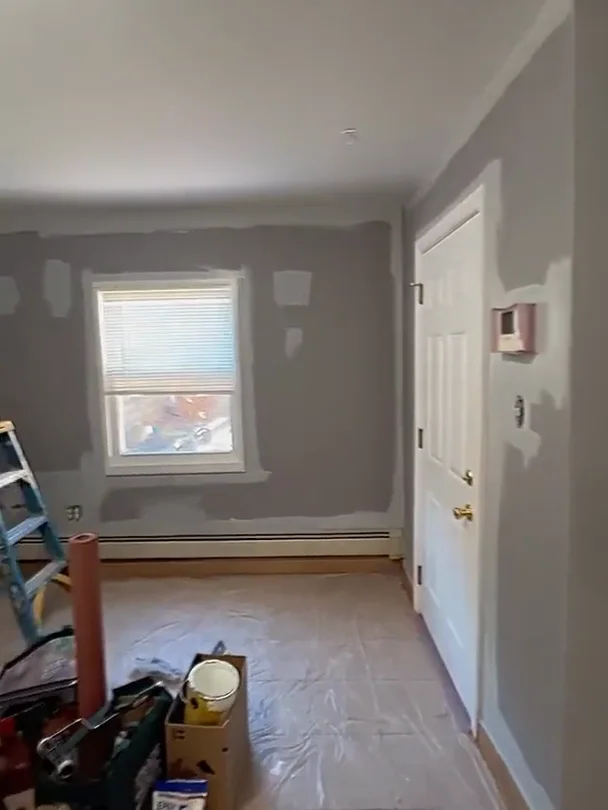
- Prep: filling nail holes, dents and hairline cracks; sanding; caulking; stain-blocking primer over water marks; spot-priming every patch so it doesn't show through the finish.
- Protection and cleanup: furniture and floors covered, daily cleanup, a final walkthrough.
Usually priced separately: skim coating, loose or water-damaged plaster, popcorn ceiling removal, wallpaper removal, cabinets and, in rentals, lead turnover work. Our interior painting page explains which sheen goes on each surface.
What changes the price of painting an apartment in NYC
Prewar plaster repair and skim coating
Most apartments built before World War II have plaster walls. Plaster is hard and durable, but decades of settling and steam heat leave hairline cracks, bulges where it has come away from the lath, and old paint that crazes and peels. Cracks are opened, filled and spot-primed before painting; walls cracked all over get a skim coat, a thin layer troweled over the whole surface to flatten it.
| Repair before painting | Typical NYC price |
|---|---|
| Hairline cracks and small patches, one room | $300–$900 |
| Loose, bulging or broken plaster section | $500–$1,500 per area |
| Water-damaged ceiling or wall section, after the leak is fixed | $550–$1,600 |
| Skim coat a bedroom (about 10×12 ft), walls and ceiling | $1,200–$3,200 |
| Drywall: several repairs across an apartment | $400–$1,250 |
Paint peeling around radiators and under windows usually traces back to moisture, such as a leaking radiator valve or condensation on cold glass. Have the super fix the source first, or you will pay to repaint the same spot.
Newer buildings are mostly drywall, where repairs are simpler. See plaster vs drywall in prewar NYC apartments to tell which you have; our plaster repair and drywall repair services cover bigger jobs.
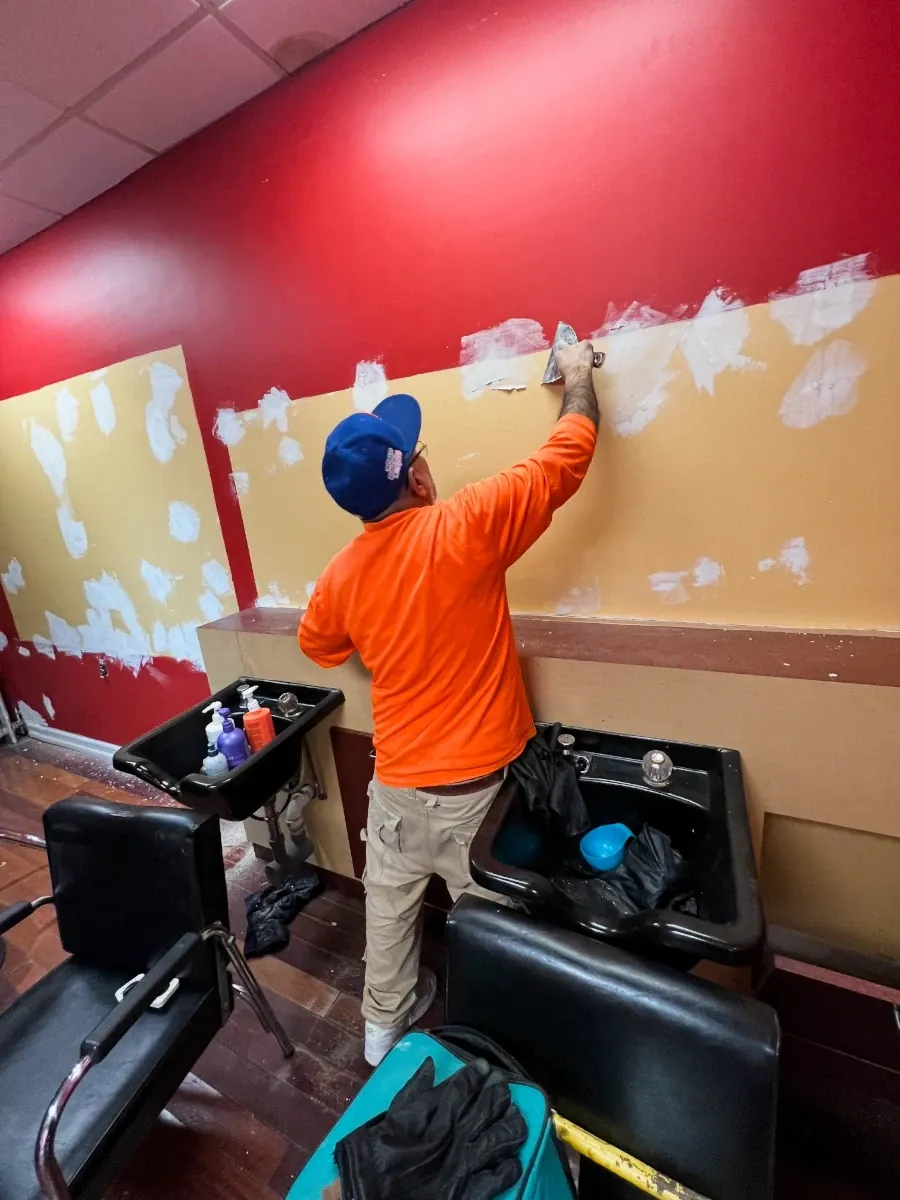
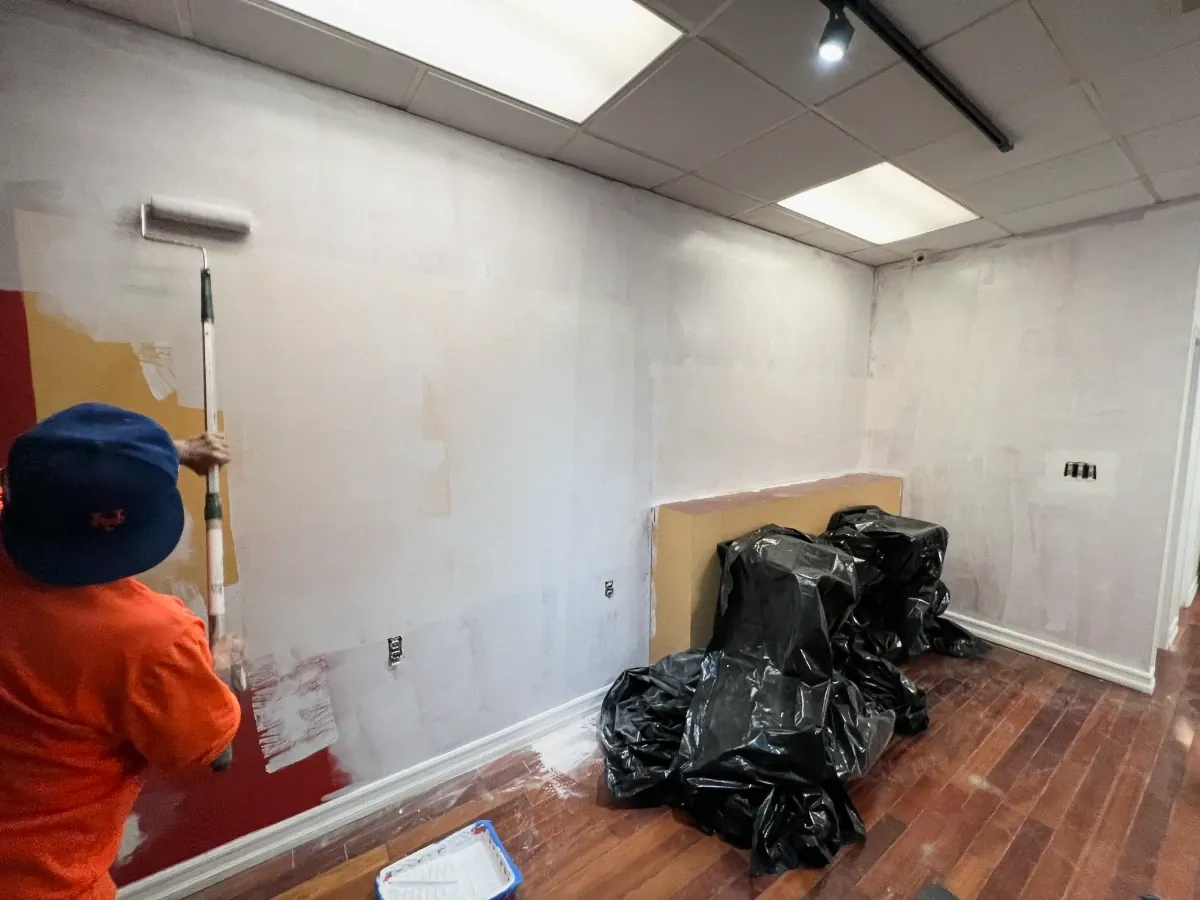
On our repaint at Salon Deana in Astoria, the damaged walls were patched, sanded and primed before any finish coat went on; apartment walls get the same prep.
High ceilings, molding and radiators
Prewar apartments often have ceilings of 9 feet or more, crown molding, deep window casings and radiators. Taller walls take more paint and taller ladders, molding is cut in by hand, and radiators are slow to paint well.
Color changes, dark colors and the number of colors
Repainting in a similar color usually takes two coats. Covering a dark color with a light one, or going to a deep color, typically needs a primer or a third coat, and deep colors show uneven walls more, which can mean more prep. One wall color, white ceilings and one trim color is the quickest scheme; every extra color adds cutting-in and cleanup. Still choosing? Our color consultation guide covers testing samples.
Empty or lived-in, and furniture moving
An empty apartment is the quickest to paint. In a lived-in one, furniture is moved and covered and rooms are painted one at a time, so you always have a usable bedroom and bathroom. That takes longer, and costs more.
Paint grade
Premium and designer paints cost two to three times as much per gallon as contractor grades. We paint with Benjamin Moore, Farrow & Ball and Fine Paints of Europe; if you have a brand or a building-standard color in mind, tell us at the estimate.
Building rules and limited work hours
Many co-ops and condos treat painting as decorative work needing only notice and the contractor's paperwork; others want a signed alteration or decoration agreement. Most ask for a certificate of insurance (COI), often naming the co-op or condo and the managing agent, and many limit work to weekdays, commonly around 9 a.m. to 5 p.m. A shorter day means more days on the job, and a late or incorrect COI can push back the start. Get the building's contractor rules and sample COI before you collect quotes, and give every painter the same information.
Elevators, walk-ups and parking
In an elevator building, the service elevator usually has to be reserved and padded; in a walk-up, ladders and paint are carried up the stairs. Parking a work van, especially in Manhattan, can mean garage fees. All of it is time on the job.
NYC landlord rules: repainting every three years
If you own rentals, repainting is a legal duty. Under the NYC Housing Maintenance Code (Administrative Code § 27-2013), the owner of a multiple dwelling, meaning a building with three or more apartments, must repaint the walls and ceilings of occupied apartments every three years, and more often when a lease or another law requires it.
- Deferral: owner and tenant can put off the repaint for up to two more years, but only in a voluntary agreement made no earlier than one month before the three-year period ends, never in the lease. HPD can still order a repaint if walls become unsanitary.
- Records: owners must record when each apartment and the public halls were last painted and who did the work, and show HPD on request. Keep every invoice.
- Tenant damage: HPD can require a tenant to repaint walls that become unsanitary within three years of the last paint job, unless the tenant shows they didn't cause it.
Landlords can budget for that cycle: repaint at vacancies where you can, use one color and sheen per building so touch-ups match, and in pre-1960 buildings combine the repaint with the lead turnover work. One of our Google reviews is from a client whose Brooklyn rental apartment we patched and painted. Renting? The repaint is the owner's job; if you want a new color, get your landlord's written consent first.
Lead-safe painting rules in older NYC buildings
Buildings from before 1978 may have lead paint under newer coats. Lead paint in good shape is usually not a problem, the EPA says; the risk is peeling paint and the dust from scraping and sanding. Three sets of rules can apply:
- EPA Renovation, Repair and Painting (RRP) rule. Anyone paid to disturb paint in housing built before 1978 must be certified, unless the work disturbs 6 square feet or less per room inside, or 20 square feet or less outside. Window replacement and demolition are always covered. Studios and other zero-bedroom units are excluded unless a child under 6 lives there. See the EPA's RRP guidance.
- HPD safe work practices. In pre-1978 buildings, HPD advises lead-safe practices for any work that disturbs 2 square feet or more of paint in a room, whether or not children live there, by a contractor with EPA renovation firm certification. See HPD's safe work practices.
- Local Law 1 of 2004 (rentals). In rental buildings built before 1960, and 1960–1978 buildings where the owner knows of lead paint, the paint is presumed to contain lead unless testing shows otherwise; co-op and condo units rented to tenants are covered. At every turnover in a pre-1960 multiple dwelling, whether or not the next tenant has a child, the owner must fix peeling paint and its causes, such as leaks; remove lead paint from the friction surfaces of doors, door frames and windows, even where the paint is intact; and make bare floors, sills and window wells smooth and cleanable before the new tenant moves in. See HPD's turnover requirements.
HPD's rules end lead work with a dust clearance test, taken by EPA-certified workers independent of the contractor that did the work. For your budget: containment, wet scraping and cleanup take longer than ordinary prep, the clearance test is a separate bill, and friction-surface work can mean replacing doors or frames. Schedule it with the repaint so the apartment sits empty once. Work that corrects a City lead-paint violation or order needs a firm with EPA lead abatement certification, not only renovation certification.
How long does it take to paint an apartment?
With a crew of two in an empty apartment, painting walls, ceilings, trim and doors with light patching, typical times are:
- Studio: one to two days
- One-bedroom: two to three days
- Two-bedroom: three to five days
Plaster repair adds the most time, because each coat of patch or skim has to dry before it is sanded and primed. Furniture, deep colors that need a third coat and short building hours add more. These are typical ranges, not promises; you get a schedule after the site visit.
How to save money on apartment painting
- Paint while it's empty, between the closing and the moving truck or between tenants.
- Keep the scheme simple: one wall color, white ceilings, one trim color.
- Stay near your current colors to avoid a primer coat or a third coat.
- Do it all at once. You pay for setup, protection and minimums once. Landlords: line the repaint up with the three-year cycle and the turnover work.
- Clear the rooms yourself: shelves, art, curtains and wall-mounted TVs.
- Don't save on prep. Skipped crack repair and spot-priming show through the new paint, and a leak left unfixed undoes it.
How to compare apartment painting quotes
Get two or three written quotes for the same scope, then check each for:
- Scope: which rooms, and which of walls, ceilings, trim, doors, closets and radiators.
- Prep: which repairs are included, and how skim coating is priced.
- Coats and primer: two finish coats, spot-priming, primer for big color changes.
- Paint: brand, product line and sheen per surface, and whether paint is included.
- Building requirements: the COI your building asks for, and work within its hours.
- Lead-safe work: in a pre-1978 building, if old paint will be disturbed, the firm's EPA RRP certification.
- Sales tax: repainting existing walls is a taxable repair service in New York (Publication 862): 8.875% in NYC, about $89 per $1,000. Check whether each quote includes it.
- Schedule and payments: start date, working days and when each payment is due.
A quote far below the others usually leaves something out, such as a coat, the closets or the prep. Ask what before you choose.
We quote every apartment after a free site visit: we look at the walls and ceilings, count the doors and closets, ask about your building's rules and give you a price and a schedule. DecoStyle USA paints apartments across Queens, Brooklyn, Manhattan, the Bronx and Staten Island, on Long Island and in Westchester.