Wallpaper Installation Cost in NYC (2026 Prices)
Wallpaper installation cost in NYC for 2026: per-roll and per-sq-ft labor by paper type, removal and prep costs, worked examples and how many rolls to buy.
- By
- DecoStyle USA
- Published
- Reading time
- 11 min
In this guide
The typical wallpaper installation cost in NYC is $2.50–$5 per square foot of wall for standard paper, or $70–$140 per single roll, labor only. Grasscloth, silk, murals and unpasted designer papers run $5–$12 per square foot. An accent wall of about 100–150 sq ft in standard paper usually costs $300–$750 to hang, and a powder room $500–$1,500. Removing old paper adds $1–$3 per square foot, up to $4–$6 for the hard cases. The paper itself is extra.
Those are typical NYC market ranges for 2026, not DecoStyle quotes, and the real cost to install wallpaper depends mostly on the wall underneath. We price every wallpaper installation job in NYC and on Long Island after a free site visit, once we have seen the walls and the paper you have chosen.
How wallpaper installers price: per roll, per square foot or per wall
| Item | Typical NYC price, labor only | Notes |
|---|---|---|
| Standard wallpaper, per sq ft of wall | $2.50–$5 per sq ft | The paper is extra and varies widely by brand |
| Standard wallpaper, per single roll (about 28 sq ft) | $70–$140 per roll | A US double roll or a 10 m European roll (about 56 sq ft) counts as two |
| Grasscloth, silk, murals and unpasted designer papers | $5–$12 per sq ft | Natural fibers show every seam; murals go up panel by panel, in sequence |
| Accent wall (about 100–150 sq ft), standard paper | $300–$750 | Small jobs often carry a minimum |
| Powder room (about 150–200 sq ft of wall) | $500–$1,500 | Cuts around the vanity, toilet and mirror |
| Wallpaper removal | $1–$3 per sq ft | Painted-over paper, several layers or paper on unprimed drywall can reach $4–$6 per sq ft, plus wall repair |
Typical NYC ranges, reviewed November 2026.
Per roll. Many NYC paperhangers price by the single roll of about 28 sq ft, so $70–$140 a roll works out to $2.50–$5 a foot. Ask what counts as a roll: many papers come in double rolls or 10-meter European rolls, and each counts as two. Per-roll pricing also means a large pattern repeat, which uses more rolls, raises the labor on the same wall.
Per square foot. The easiest way to compare quotes, because it does not depend on roll size or pattern.
Per wall or per room. Accent walls and powder rooms are often quoted as one price. Many hangers also have a minimum charge, because covering the floor, setting a plumb line, mixing paste and cleaning up take nearly as long for one wall as for four.
Free estimate
Want a quote for this?
DecoStyle USA does wallpaper installation across NYC and Long Island. Free site visit, written quote.
Wallpaper Installation in NYCWallpaper installation cost by paper type
The backing decides how a paper goes up, and that decides most of the labor.
| Paper type | How it goes up | Typical NYC labor |
|---|---|---|
| Standard pre-pasted paper | Dry adhesive on the back, activated with water | $2.50–$5 per sq ft |
| Non-woven, paste-the-wall | Adhesive rolled on the wall, paper hung dry | $2.50–$5 per sq ft |
| Unpasted traditional paper | Pasted on the back, booked, then hung | $2.50–$5 per sq ft; unpasted designer papers $5–$12 |
| Grasscloth and natural fibers | Adhesive on the back only; strips laid out and often reverse-hung | $5–$12 per sq ft |
| Murals and panel sets | Numbered panels placed in order, often double-cut on the wall | $5–$12 per sq ft |
| Commercial Type II vinyl | Wide, heavy goods for high-traffic walls | Quoted per project |
Paste the wall or paste the paper?
It depends on the backing. Pre-pasted papers are wetted and hung; non-woven papers go up dry on a pasted wall. Both are quick. Traditional unpasted paper is pasted on the back and booked, folded paste to paste and left to relax so it expands before it meets the wall; Schumacher's hanging guidelines specify 5–7 minutes. Every strip is handled twice, so it is slower. Many designer papers work this way; Farrow & Ball sells almost all of its papers as paste-the-paper. Some makers also call for a lining paper first (Schumacher does for its paper, metallic and foil wallcoverings), which means hanging a whole second layer.
Grasscloth and natural fibers
Grasscloth is woven from grasses or plant fibers such as sisal on a paper backing, usually 36 inches wide (Wolf-Gordon's glossary). Shading varies from strip to strip and the seams show, so the installer lays out each wall first and often reverse-hangs alternate strips to even out the color. Paste must stay off the face, and the finished wall cannot be washed, so keep it away from sinks and stoves.
Murals and panel sets
Murals come as numbered panels printed for one wall, often priced by the panel. Calico, for example, asks you to add at least 2 inches to each wall dimension and round up to the nearest panel, and most of its collections are pasted on the back, booked and double-cut on the wall.
Commercial Type II vinyl
Vinyl is graded by strength under Federal Specification CCC-W-408D. Wolf-Gordon's glossary lists Type II (at least 13 oz per square yard) for medium- to heavy-duty, high-traffic walls, between the lighter Type I and the heavier Type III. Commercial wallcoverings also carry a fire rating from the ASTM E84 tunnel test (Class A, B or C), so check it against what your architect or building requires before ordering. This guide gives no typical range: restaurant, shop and office jobs vary too much with after-hours work and phasing (see our commercial painting page).
How much does it cost to hang wallpaper? Three worked examples
Multiply each wall's width by its height, subtract large openings such as doors and windows, and multiply by the rate. All prices are labor only.
| Job | Wall area | Standard paper, by the foot | Grasscloth or designer paper, by the foot | Typical NYC job price |
|---|---|---|---|---|
| Accent wall, 12 ft wide, 9 ft ceiling | 108 sq ft | $270–$540 | $540–$1,296 | $300–$750 (standard paper) |
| Powder room, 5 × 6 ft, 8 ft ceiling | about 160 sq ft | $400–$800 | $800–$1,920 | $500–$1,500 |
| Bedroom, 10 × 12 ft, 8 ft ceiling | about 320 sq ft | $800–$1,600 | $1,600–$3,840 | Priced by the foot or per roll |
Accent wall
At 108 sq ft, this wall comes to $270–$540 at standard rates, but minimum charges mean a standard-paper accent wall typically lands at $300–$750. If the wall needs a skim coat first, add about $270–$648 at $2.50–$6 per sq ft. For comparison, a Venetian plaster accent wall typically costs $1,500–$4,500.
Powder room
A 5 × 6 ft powder room with an 8 ft ceiling has about 176 sq ft of wall, about 160 after the door. That is $400–$800 by the foot, but cutting around the vanity, toilet, mirror, casing and lights, with no room to step back, puts the typical job at $500–$1,500. With no shower, most papers suit a powder room, but keep grasscloth clear of the sink.
Bedroom
A 10 × 12 ft bedroom with an 8 ft ceiling has 352 sq ft of wall, about 320 after a door and a window. Painting the same walls typically costs $500–$1,000 in NYC, paint included (NYC painting costs). In a prewar apartment, each extra foot of ceiling height adds 44 sq ft of wall, or $110–$220 at standard rates.
In that bedroom, prep can cost more than hanging: removing painted-over paper at $4–$6 per sq ft comes to $1,280–$1,920, and a full skim coat at $2.50–$6 adds $800–$1,920 before the first strip goes up.
Wallpaper removal cost and wall prep
Removal typically runs $1–$3 per square foot in NYC. What sits on the wall, and what the wall is made of, decide where a job lands.
- Strippable paper is made to come off dry in whole strips. This is the low end.
- Peelable paper loses its face and leaves the backing and glue behind, to be soaked and scraped.
- Traditional paper is soaked, scored and scraped. The Wallcovering Installers Association suggests letting it soak at least 10 minutes.
- Painted-over paper is the slowest, because the paint keeps water out; it can reach $4–$6 per square foot.
- Several layers over plaster take time, but plaster is the forgiving case: the WIA notes that scoring tools can damage drywall but are gentler on plaster.
- Paper on unprimed drywall is the hard case. Without a primer between them, the paste grips the drywall's paper face, so stripping can tear it, and the torn face has to be repaired before anything goes back up.
Then the old paste is washed off and the wall repaired. Typical NYC prices:
| Prep item | Typical price |
|---|---|
| Hairline cracks and small patches, one room | $300–$900 |
| Loose, bulging or broken plaster section | $500–$1,500 per area |
| Water-damaged ceiling or wall section, after the leak is fixed | $550–$1,600 |
| Skim coat, walls or ceilings | $2.50–$6 per sq ft |
Wallpaper shows the wall underneath, especially thin papers, metallics and anything with a sheen. Prewar NYC apartments often have cracked, bulging original plaster under decades of paint, which needs repair and often a skim coat before hanging. Loose or water-damaged plaster is a plaster repair job first; our guide to plaster vs drywall in prewar NYC buildings explains why old walls behave the way they do.
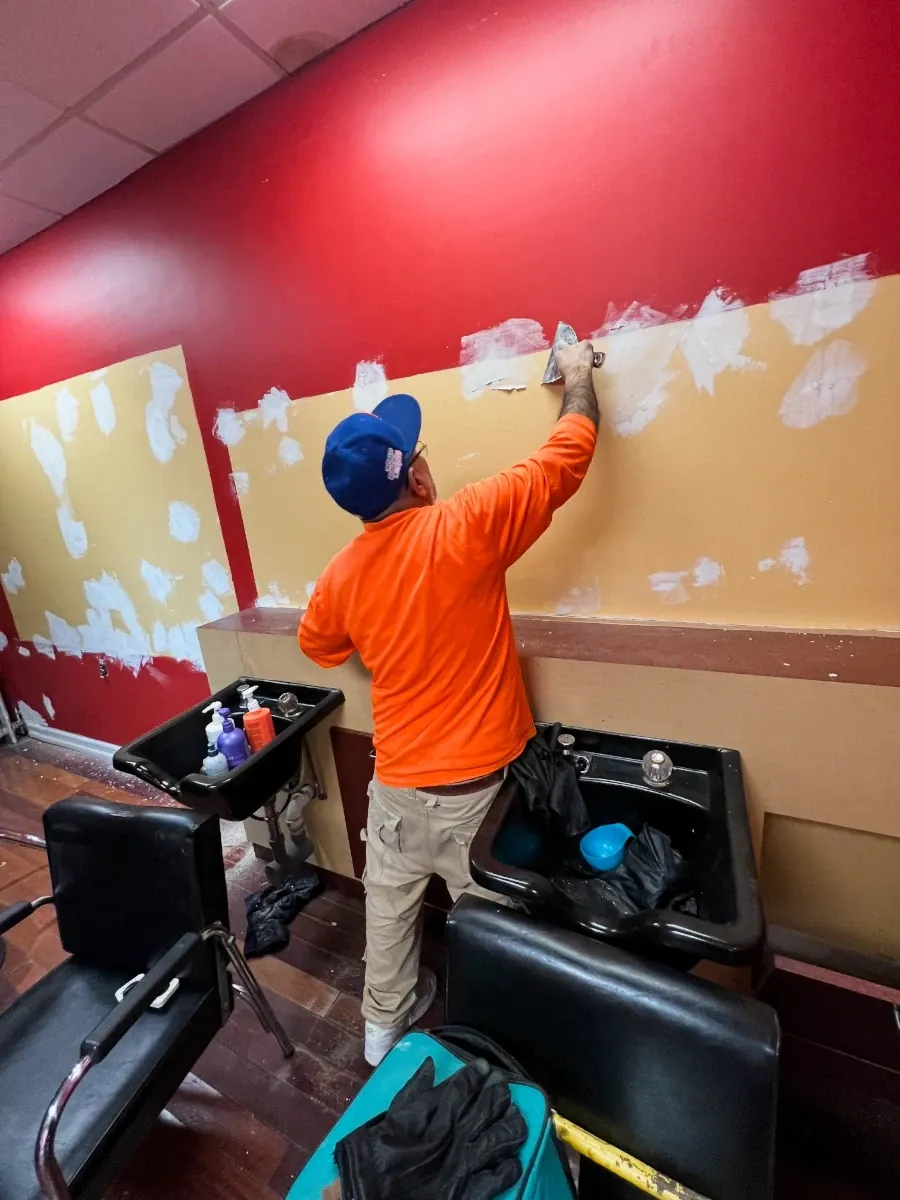
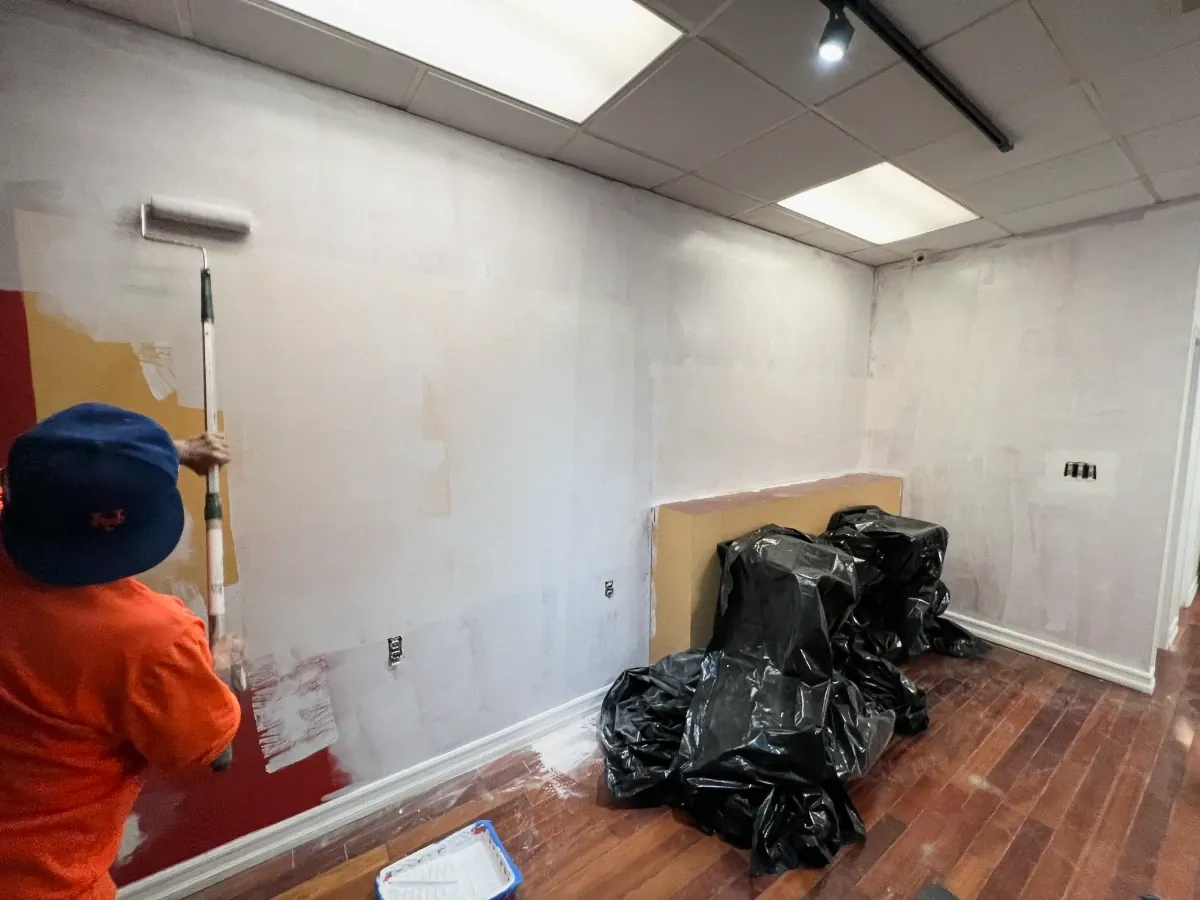
At Salon Deana in Astoria we patched, skim-coated and primed damaged walls before the new finish went on; the prep is the same for paper or paint.
For wallpaper, the last step is a primer made for wallcovering (Schumacher calls for a hard, pigmented acrylic one). Makers also want a dry wall: Schumacher sets a limit of 4 percent moisture on a meter (5.5 percent on plaster and masonry) and wants unpainted walls at least 90 to 120 days old, so fix any leak first.
In homes and apartments built before 1978, the EPA's Renovation, Repair and Painting rule requires certified firms and lead-safe work practices when paid work disturbs more than six square feet of paint per room. Scraping painted-over paper or sanding for a skim coat goes well past that, so containment and cleanup belong in the price.
How much wallpaper do you need?
The quick estimate. Divide the wall area by one roll's coverage and add 10–15 percent, more for a large or half-drop repeat. A roll covers less than its label: the Wallcovering Installers Association's estimating example uses 25 sq ft per single roll, not the nominal 28.
The accurate count, by strips:
- Divide the wall width by the roll width and round up. That is the number of strips.
- Add about 4 inches to the wall height for trimming (York suggests about 2 inches at the ceiling and 2 at the baseboard), plus one pattern repeat. That is the length of each strip.
- Divide the roll length by the strip length and round down. That is the number of whole strips per roll.
- Divide the strips needed by the strips per roll and round up.
Take the 12 × 9 ft accent wall above, in rolls 20 inches wide and 32 feet long (Farrow & Ball lists that size, for example). 144 inches ÷ 20 = 7.2, so 8 strips. A random-match paper needs strips of 112 inches: 3 per roll, so 3 rolls. With a 21-inch half-drop repeat, each strip needs about 133 inches: only 2 per roll, so 4 rolls. The percentage rule (108 sq ft plus 15 percent, about 124 sq ft, or 2.3 rolls of 53 sq ft) would have rounded to 3 and left you a roll short.
Grasscloth, commercial vinyl and murals come in other widths or by the panel, so count them separately. Three habits save money:
- Order everything at once, from one run. Color can vary between print runs, so note the pattern and dye lot numbers and buy every roll together.
- Check before cutting. Confirm pattern, dye lot and roll count before hanging, then stop and inspect after three strips: Schumacher and Phillip Jeffries both refuse claims once more than three strips are up.
- Don't over-order blindly. Some makers accept no returns for overage. Have the installer measure before you buy.
What drives wallpaper installation cost in NYC
Prewar walls and ceilings. Old plaster needs repair, walls are often out of plumb, and 9- or 10-foot ceilings mean longer strips and planks or a taller ladder.
Pattern repeat. Random matches lose almost nothing to matching; straight and drop matches lose paper on every strip, and a large repeat also takes longer to line up at each seam.
Cuts and access. Radiators and their pipes, outlets, window casings and built-ins all mean careful cuts. Stairwells and ceilings need scaffolding or planks.
Building rules. Most NYC co-ops and condos ask contractors for a certificate of insurance, many limit work to weekday hours, and the service elevator has to be booked. Ask your managing agent early.
Heat and moisture. Schumacher wants the room kept above 55°F for three days after hanging, so a winter renovation needs the heat on.
How to get an accurate wallpaper quote
- Photos. Each wall in daylight, close-ups of cracks and old seams, and one shot with a flashlight held flat against the wall.
- Dimensions. Each wall's width, the ceiling height, doors and windows. A sketch is enough.
- The paper. Brand, pattern, roll size, repeat and match, and how it is pasted.
- What is on the wall now. Paint or paper, how many layers, painted over or not, plaster or drywall, and the building's age.
- Building rules. Your co-op or condo's insurance requirements, work hours and elevator booking.
- Like-for-like bids. The Wallcovering Installers Association suggests two or three bids, not automatically the lowest, and a written contract that lists patterns, quantities, protection and cleanup. Check whether removal, repairs, skim coating, primer and lining paper are included, and what counts as a roll.
DecoStyle USA hangs wallpaper across Queens, Brooklyn, Manhattan, the Bronx, Staten Island, Long Island and Westchester, and handles the plaster and drywall repair underneath as part of the same job. Send photos, measurements and the paper you have in mind through our contact page, and we will arrange a free site visit and estimate.