Skip to content

Walls & ceilings · NYC & Long Island

Drywall Repair in NYC

Drywall repair in NYC fixes everyday damage to walls and ceilings: nail pops, dents, doorknob holes, cracked tape seams and leak-damaged board. We prime and repaint the repair as part of the same job.

5.0 from 9 Google reviews (opens Google Maps)
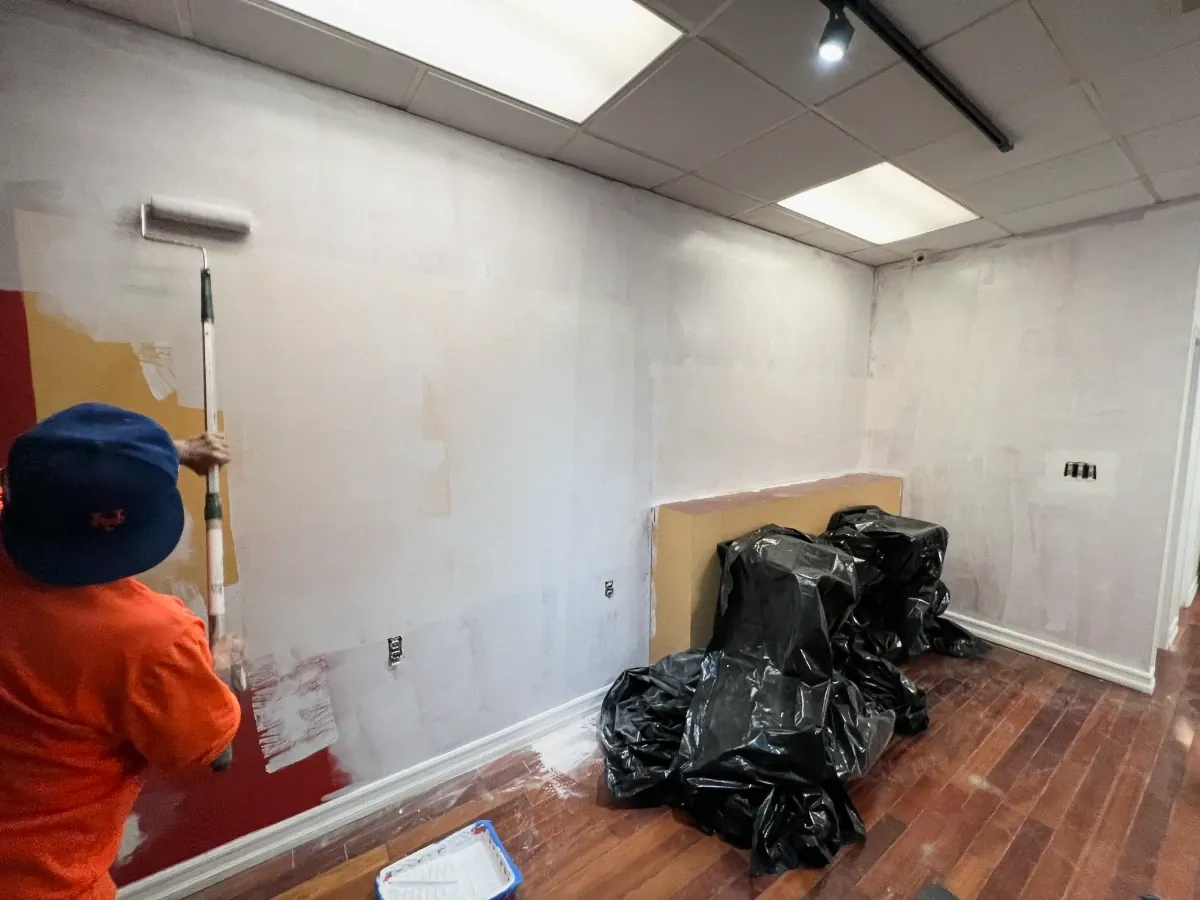
Primer being rolled onto patched walls at Salon Deana

At a glance

DecoStyle USA repairs drywall for homeowners, renters, landlords and businesses across New York City and Long Island, from Queens and Brooklyn to Nassau and Suffolk.

Typical NYC prices run about $200–$450 for a visit to fix several small holes and nail pops, $300–$700 per patch for larger holes that need new board, and $550–$1,600 to replace water-damaged drywall once the leak is fixed. We quote after a free site visit.

Why DecoStyle

Why choose DecoStyle USA for drywall repair

What's included

What our drywall repair and patching covers

  • Nail and screw pops reset, filled and sanded
  • Dents, gouges and old anchor holes filled
  • Doorknob and larger holes patched with new board
  • Cracked tape seams cut out and re-taped
  • Dented corners rebuilt with new corner bead
  • Water-damaged drywall replaced after the leak is fixed
  • Ceiling holes, cracks and water stains
  • Patches blended into smooth walls or matched to a texture
  • Skim coating to a Level 5 finish before painting
  • Spot-priming, stain-blocking primer and repainting to match

Options

Levels of drywall finish, explained

The Gypsum Association's GA-214 standard grades drywall finishing from Level 0 (nothing taped) to Level 5. Check which level a quote includes.

  • 01

    Levels 1 and 2: hidden walls and tile

    Tape set in compound and little more. Used where nobody sees the board, such as above a dropped ceiling, or under tile.

  • 02

    Level 3: heavy texture

    An extra coat over joints and screw heads. Enough under heavy texture or heavy wallcovering, not under paint on a smooth wall.

  • 03

    Level 4: flat paint

    Joints and screws finished with further coats and sanded smooth. The standard base for flat paint on walls without strong side light.

  • 04

    Level 5: skim coat over everything

    Level 4 plus a thin skim coat over the entire surface. Recommended under glossier paints and strong, low-angle light, and the smoothest base for Venetian plaster.

Common drywall problems in NYC apartments and houses

Not sure your walls are drywall? Knock: drywall sounds hollow between studs and shows a paper face where torn; plaster sounds solid and feels hard and cold. Prewar plaster needs different repairs, covered on our plaster repair page. The usual drywall problems, with New York's twists:

  • Drywall over old walls. Many prewar apartments are a patchwork: original plaster in most rooms, drywall where a renovation added a kitchen, bathroom or partition, or covered cracked plaster. The seam where new board meets old plaster often cracks, and a hole may reveal plaster, lath or brick behind the board, which changes the repair.
  • Leaks from upstairs. A bathroom or radiator leak above shows up as a brown ring, bubbling paint or a soft, sagging patch of ceiling. The leak is fixed first (see below).
  • Doorknob holes. A door without a stop punches a fist-sized hole behind the handle. It gets new board on proper backing, and the door gets a stop.
  • Settling seams. Tape seams, inside corners and the corners above doors and windows crack as a building moves. Refilling a crack that's still moving only hides it until next season, so the loose tape is cut out and replaced.
  • Nail and screw pops. Small round bumps, often in a line along a stud, where a fastener has loosened. A new screw beside it pulls the board tight, then the old head is set or removed and filled.

Making a patch disappear: texture and raking light

Raking light, meaning daylight or a sconce skimming along the wall at a low angle, throws a shadow off every ridge. On a smooth wall there's no texture to hide a repair, so the patch has to be truly flat.

Holes and deep cracks are filled with setting-type compound, which hardens by chemical reaction rather than by drying alone and shrinks far less than ready-mixed compound, so the fill doesn't sink a day later. Finish coats go on thin and are feathered well past the edges of the repair. Each coat is sanded and checked with a work light held flat to the wall before the next.

Textures such as orange peel or knockdown are matched in pattern and scale before priming. Popcorn ceilings are a special case: they should be tested for asbestos before anyone cuts into them.

Fresh compound soaks up paint differently from the wall around it, so an unprimed patch shows as a dull or shiny spot, called flashing. Every repair is spot-primed before the wall is repainted.

Level 5 finish and skim coating before painting

A skim coat is a thin layer of joint compound spread over the whole wall and sanded smooth. On drywall, it turns a Level 4 wall into Level 5, so taped seams and screw heads stop showing through paint. Federal construction specifications call for Level 5 wherever drywall gets eggshell, semi-gloss or gloss paint, or where severe lighting hits the wall.

At home it's worth it beside big windows and under wall-washing lights, under dark colors and glossier sheens, under Venetian plaster and metallic finishes, and on walls scarred by years of patches or wallpaper removal. It typically costs $1.50–$3.50 per sq ft in NYC; the video on this page shows a skim coat going on by hand.

Dust control in occupied apartments

Sanding joint compound makes a fine powder that drifts through doorways and into vents. In an apartment you're living in, containing it matters as much as the repair.

In a home built before 1978, cutting or sanding painted drywall or plaster can also release lead dust. Under the EPA's Renovation, Repair and Painting rule, paid work that disturbs more than 6 square feet of paint per room in pre-1978 housing, or demolishes painted surfaces, must be done by a certified firm using lead-safe practices. In NYC, HPD advises lead-safe practices from 2 square feet per room in pre-1978 buildings, and Local Law 1 adds landlord duties in pre-1960 rentals. Ask any contractor about this before work starts.

How we keep dust down:

  • Compound laid on thin and smooth, so each coat needs only a light sanding.
  • Floors covered from the door to the work; furniture, shelves and electronics moved or wrapped.
  • Plastic over the doorway of any room being sanded, and its vents covered or the system off.
  • Small patches smoothed with a damp or fine sanding sponge.
  • Vacuuming and wiping down at the end of every day, never dry sweeping.

Water-damaged drywall: call the plumber or landlord first

If the stain is still growing, the ceiling is wet or the board is soft, drywall repair is the second call, not the first. A patch over an active leak will fail, and wet board sealed behind fresh paint can grow mold.

Don't paint over mold: the EPA warns that paint over moldy surfaces is likely to peel, and the mold stays underneath. In NYC buildings with 10 or more apartments, mold covering more than 10 square feet must be handled by state-licensed mold assessors and remediators. We replace the drywall and paint after that work is done. The order that works:

  • Stop the water. Call the super, the managing agent or the neighbor upstairs. If water drips from a light fixture or near outlets, stay clear and have that circuit switched off; if the ceiling sags, keep everyone out from under it.
  • Document it. Photograph the stains, the source and damaged belongings before anything is cut out. The building and your insurer will ask.
  • Dry it. The EPA advises drying water-damaged areas within 24 to 48 hours to prevent mold.
  • Keep or replace. EPA guidance says wallboard may be dried in place if there's no obvious swelling and the seams are intact; if not, it's removed and replaced.
  • Repair, seal, paint. New board, tape and finish coats, then a shellac- or oil-based stain blocker over remaining water marks, which bleed through ordinary latex, then paint.

Free estimate

Get a written quote for your drywall repair job

We visit, look at the walls, measure and talk through the finish. Then you get the scope, products and schedule in writing.

Mon–Fri 9:00 am–7:00 pm · Sat 9:00 am–5:00 pm

5.0 from 9 Google reviews (opens Google Maps)

Typical NYC prices

Drywall repair cost in NYC

These are typical NYC ranges for 2026, not DecoStyle quotes. Drywall repair is priced by the visit and the repair more than by the square foot, because each coat of compound has to dry before the next. We quote after a free site visit and can include repainting in the same quote.

Drywall repair cost in NYC
ItemTypical NYC range
Small holes, dents and nail pops (one visit)Several small repairs filled, sanded and spot-primed. Most pros have a minimum visit charge.$200–⁠$450
Larger patch (up to about 2×2 ft)New drywall piece, taped and finished; usually two visits to let compound dry.$300–⁠$700 per patch
Water-damaged drywall, cut out and replacedAfter the leak is fixed.$550–⁠$1,600
Several repairs across an apartment$400–⁠$1,250
Level 5 skim coat over drywallFor a flat, smooth wall under raking light, dark colors or decorative finishes.$1.50–⁠$3.50 per sq ft

Typical NYC ranges, reviewed November 2026. DecoStyle quotes every job after a free site visit.

What moves the price

  • Size and number of holes, and whether they sit on walls or ceilings.
  • Visits: joint compound needs drying time, so larger patches take two or three visits.
  • Water damage: wet or moldy drywall is cut out and replaced once the leak is fixed.
  • Finish level: matching a smooth wall or a textured ceiling.
  • Paint: a touched-up patch rarely matches, so the whole wall is usually repainted.
  • Minimum visit charges for small jobs.

Get a price for your drywall repair job

Ranges are a starting point. We quote after a free site visit, once we've seen the walls, the space and your building's rules.

How it works

Our drywall repair process, step by step

From the free site visit to the final walkthrough, in the order the work actually happens.

  1. Step 1: Free site visit

    We check each repair and whether water is still involved, and tell you what can be patched and what must be replaced.

  2. Step 2: Protect the room

    Floors and furniture covered, sanding areas closed off with plastic, building rules on hours and hallways followed.

  3. Step 3: Cut out and rebuild

    Damaged board cut back to sound material, backing added, a new piece screwed in and the seams taped.

  4. Step 4: Fill, finish and sand

    Setting compound for deep fills, thin finish coats feathered wide, light sanding checked under a low work light.

  5. Step 5: Prime and paint

    Repairs spot-primed, water marks sealed with a stain blocker, and the wall or ceiling repainted to match.

  6. Step 6: Clean up and walk through

    We clean up and walk through the repairs with you in good light before we pack up.

Our work

Photos from our drywall repair work

Real DecoStyle USA jobs, photographed on site. No stock photos, no renderings.

  • DecoStyle painter patching and sanding a salon wall before priming
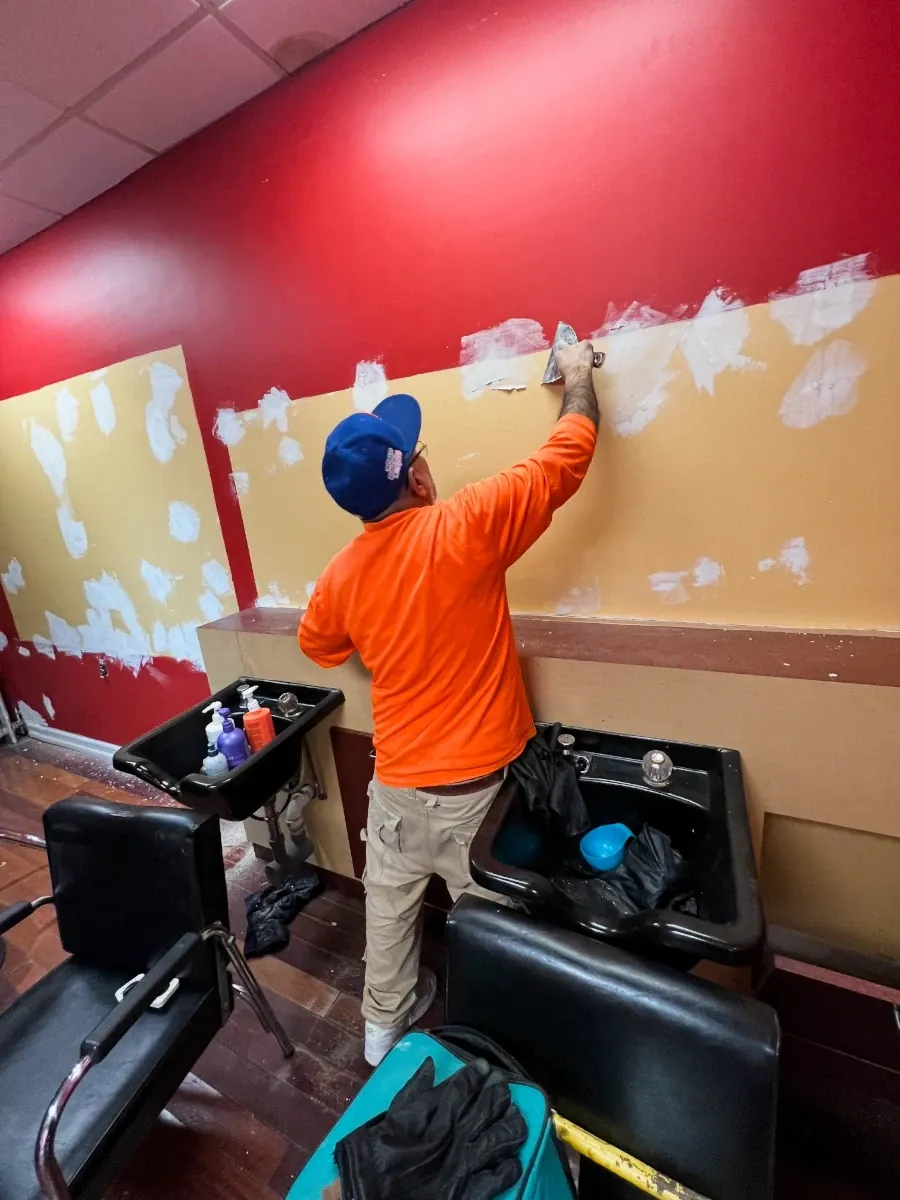
    Patching and sanding at Salon Deana in Astoria: every patch is sanded flat before primer.
  • Salon Deana before the renovation, with a red accent wall and a cluttered front desk
    Salon Deana before the work: years of fixtures and daily wear had left holes and damaged patches.
  • Salon Deana after the repaint and floor refinishing, with clean walls and open shelving
    Salon Deana after: walls patched, skim-coated, primed and repainted.

Skim coating a wall by hand

Close-up of a DecoStyle USA finisher skim coating a wall with a trowel before painting.

Clients' words

What clients say about our work

Quoted word for word.

5.09 Google reviews. 5.0 out of 5 from 9 Google reviews. Opens Google Maps.
  • “I hired DecoStyle USA to patch and paint a rental property in Brooklyn. Renis and his team were phenomenal. Renis was professional, reasonably priced, and very communicative throughout the whole process. His team not only made the apartment look great but they cleaned up so well after finishing the project, you wouldn't even know they were there. The before and after photos say it all. Looks like a brand new apartment! I highly recommend working with DecoStyle.”

    Tom BaranRental apartment patch and paint, Brooklyn

Questions

Questions about drywall repair

Something we haven't covered? Call (332) 323-0909 or email us.

How much does drywall repair cost in NYC?

Typical NYC prices are about $200–$450 for a visit to fix several small holes and nail pops, $300–$700 per patch for larger holes up to about 2 by 2 feet, and $550–$1,600 to replace water-damaged drywall once the leak is fixed. A Level 5 skim coat runs about $1.50–$3.50 per sq ft. Repainting the whole wall is usually priced separately. We quote after a free site visit.

Can painters repair drywall?

Yes. Patching holes, nail pops and hairline cracks is part of preparing any wall for paint. Bigger repairs, like replacing water-damaged board or re-taping failed seams, are drywall finishing work. We do both, then paint, so one crew answers for how the patch looks.

Can I repair drywall myself?

Small nail holes and dents, yes: lightweight spackle, a putty knife, a light sanding and primer before paint. Larger holes need backing, new board, tape and several thin coats, and the hard part is making the patch disappear in side light. In a home built before 1978, have old paint tested for lead before you sand or cut it.

How long does drywall repair take?

A few small holes and nail pops can often be finished and primed in one visit with quick-setting compound. A larger patch or water-damage repair typically takes two or three visits, because each coat has to dry before it's sanded. Painting follows. You get a schedule after the site visit.

Do I need to repaint the whole wall after a drywall patch?

Usually, yes. Touch-up paint over a primed patch rarely matches the sheen and tone of paint that has aged on the wall, even in the same color, so it shows in side light. Repainting corner to corner hides it.

Can water-damaged drywall be saved?

Sometimes. EPA guidance says wallboard may be dried in place if there's no obvious swelling and the seams are intact; otherwise it should be replaced. Soft, crumbling, sagging or moldy board comes out. The leak has to be fixed and the area dried first, and leftover stains need a stain-blocking primer.

Who pays to fix drywall after a leak from upstairs?

If you rent, it's usually the landlord's job: New York law requires landlords of apartment buildings to keep apartments in good repair, and the city's Health Department says owners of buildings with three or more apartments must keep homes free of mold, including fixing the leaks behind it. Tell the landlord or super, then put it in writing; if nothing happens, call 311.

In a co-op or condo it depends on the proprietary lease or bylaws and the insurance involved. Photograph the damage and tell the managing agent and your insurer before repairs begin.

What is a Level 5 drywall finish, and do I need one?

Level 5 is the top grade in the Gypsum Association's GA-214 standard: joints and screws finished as for Level 4, then a thin skim coat over the whole wall. You need it where strong side light or glossier paint would show seams, and under decorative finishes. In NYC it typically costs $1.50–$3.50 per sq ft.

Do you do drywall repair in Queens and the rest of NYC?

Yes. Most of our documented jobs are in Queens, and we also work across Brooklyn, Manhattan, the Bronx, Staten Island and Nassau, Suffolk and Westchester counties. In Brooklyn, for example, we patched and repainted a rental apartment; the client's Google review is on this page. The site visit and estimate are free.

Guides

Read before you hire

All guides

Free site visit & written quote

Book a free estimate

Tell us about the walls, the finish you have in mind and the timing. We'll come and look, then send a written quote.

Business hours

Monday – Friday
9:00 am – 7:00 pm
Saturday
9:00 am – 5:00 pm
Sunday
Closed
5.0from 9 Google reviews · read them on Google