Roman Clay vs Limewash vs Venetian Plaster: Look, Wear and NYC Cost
Roman clay vs limewash vs Venetian plaster: how each looks, wears and handles moisture, which suits your room, and typical NYC prices per square foot.
- By
- DecoStyle USA
- Published
- Reading time
- 11 min
In this guide
Roman clay vs limewash vs Venetian plaster comes down to two questions: how much depth you want, and how hard the wall has to work. Limewash is a brushed-on lime paint: very flat, chalky and cloudy, the least expensive of the three, and the natural choice for brick. Roman clay is a clay-based finish knifed on in thin coats: smooth, very matte and stone-like, for dry interior walls only. Venetian plaster is lime and marble troweled on in paper-thin coats and burnished, from soft matte to high polish: the most depth, the toughest surface and the highest price. In NYC, interior limewash typically costs $3–$8 per sq ft installed, Roman clay $8–$18 and polished Venetian plaster $15–$30.
All prices on this page are typical NYC market ranges, not DecoStyle quotes.
Roman clay vs limewash vs Venetian plaster at a glance
| Item | Limewash | Roman clay | Venetian plaster |
|---|---|---|---|
| Look | Very flat and chalky, with soft, cloudy brush movement | Very matte and smooth to the touch, mottled like soft stone | The depth of polished stone, from matte to high gloss |
| Material | Slaked lime thinned with water and tinted | A clay-based coating (Roman Clay is a Portola Paints product) | Slaked lime and powdered marble; acrylic versions also exist |
| How it goes on | Wide brush, two or three thin coats | Knife or trowel: base coat, light sanding, final coat, optional topcoat | Steel trowel, two to five paper-thin coats, the last one burnished |
| Durability and cleaning | Not washable; grease and skin oils mark it. Outside, it weathers slowly instead of peeling | More delicate than paint; washable with mild soap once sealed; touch-ups are hard to hide | Hard once cured; wipes clean when sealed or waxed; chips patch with the same plaster |
| Moisture and breathability | Breathable and mold-resistant; at its best on bare masonry | Dry interior walls only; not for showers or exteriors | Breathable and mold-resistant; sealed in kitchens and baths; showers only with a dedicated system |
| Best for | Brick and stone inside and out, bedrooms, living rooms | Living rooms, bedrooms, dining rooms, feature walls | Entries, stairwells, powder rooms, fireplace walls, shops and offices |
| Typical NYC cost, installed | $3–$8 per sq ft inside; $4–$10 on exterior brick or stucco | $8–$18 per sq ft | $15–$30 per sq ft polished; $12–$25 marmorino and textured |
| DIY-friendly? | Yes, with gloves and eye protection | On a small, smooth wall | Hard to do well |
For scale, plain interior painting typically runs $1.50–$3 per sq ft of wall in NYC.
Free estimate
Want a quote for this?
DecoStyle USA does Venetian plaster across NYC and Long Island. Free site visit, written quote.
Venetian Plaster in NYCLimewash: breathable lime paint, made for masonry
Limewash is slaked lime thinned with water and tinted. Unlike latex paint, it doesn't form a plastic film: on bare brick, stone or stucco it soaks in and hardens as the lime absorbs carbon dioxide from the air, letting moisture in the masonry escape, and Romabio says it won't peel or flake on unpainted surfaces. Lime is also strongly alkaline (Romabio lists a pH of 13 for its brick limewash) and resists mold.
We use Romabio for limewash and mineral paint, in two main forms:
- Brick, stone and stucco. Classico Limewash is designed for unpainted, absorbent masonry inside or out and needs no primer there. Fresh limewash can be washed back with water for a worn, old-brick look, and Romabio says it stays reversible for the first five to seven days.
- Painted interior walls. Classico can go over drywall or paint, but only on top of a Romabio primer, and Romabio gives no guarantee over every previously painted surface. The simpler route indoors is Velatura Mineralwash: two brushed coats on painted or unpainted drywall, with no primer over sound paint, for a soft, layered, very flat finish.
The trade-off is wear: Romabio says Velatura is neither washable nor stain-resistant and isn't for high-traffic areas; marks are touched up, and sometimes a wall is redone edge to edge. Grease, food and body oils stain limewash, so skip it beside a range or behind a headboard you lean on. Wet limewash is also caustic: Romabio's safety data sheet warns of serious eye damage, so wear gloves and eye protection.
Roman clay: a matte clay finish for smooth interior walls
Roman Clay is made by Portola Paints in Los Angeles: a clay-based coating with no added VOCs, applied with a putty knife or trowel. This section follows Portola's technical data sheet; if you're quoted another clay finish, read its own.
Over a primed, smooth wall, a thin base coat is pulled on with a wide knife, high spots are sanded with very fine paper, and a final coat in shorter strokes brings out the movement. Unsealed, it is very matte and smooth to the touch, with a mottled, marble-like look; the optional topcoat adds an eggshell sheen and slightly deepens the color.
Three limits matter:
- It needs a smooth wall. Portola designed it for smooth interior drywall, ideally a Level 5 finish; it won't fill holes or imperfections, and orange-peel texture causes trouble.
- It's for dry interior walls. Not for showers or exteriors. The topcoat protects busy walls from dirt and wear but doesn't waterproof or stain-proof the finish, so Portola rules it out where water or grease hits the wall constantly, such as a kitchen backsplash.
- Repairs show. Portola calls it more delicate than regular paint and says touch-ups are tricky to make seamless. Its earthy clay base also rules out some bright whites.
Venetian plaster and lime plaster walls
Venetian plaster (stucco veneziano) is slaked lime and powdered marble, laid on with a steel trowel in very thin coats; the last coat is burnished as it dries, and the burnishing sets the sheen. Marmorino uses a coarser marble grain for a more matte stone look. Acrylic versions bound with resin also exist and behave differently; ask which product you're getting.
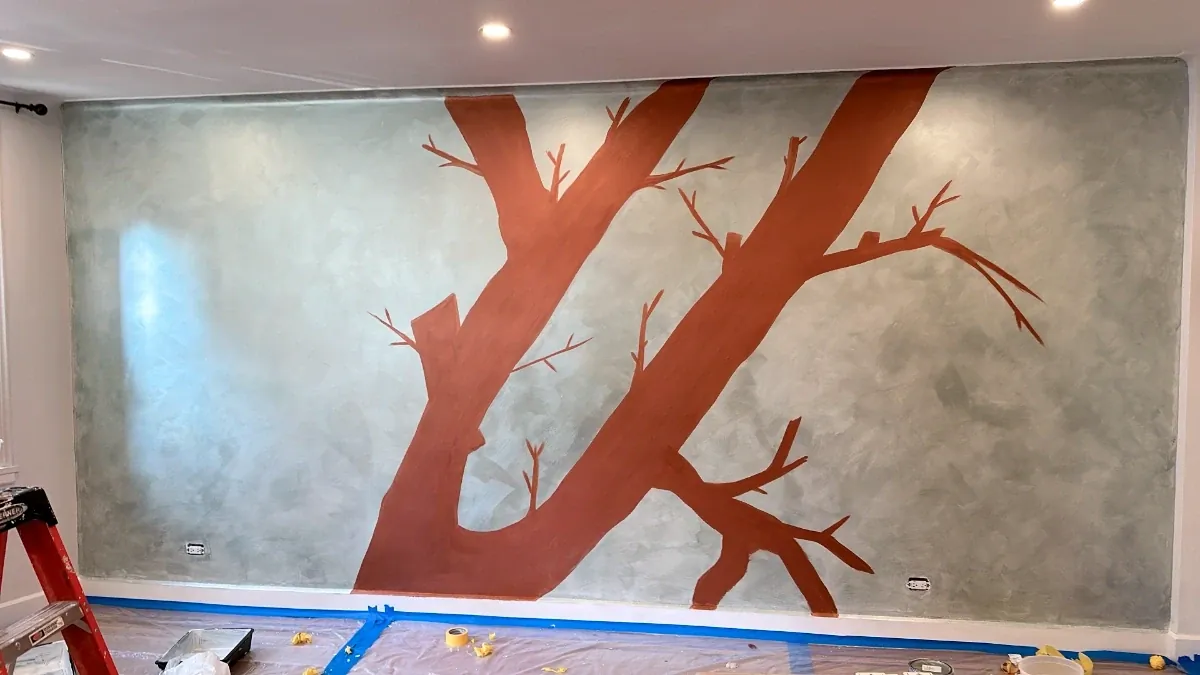
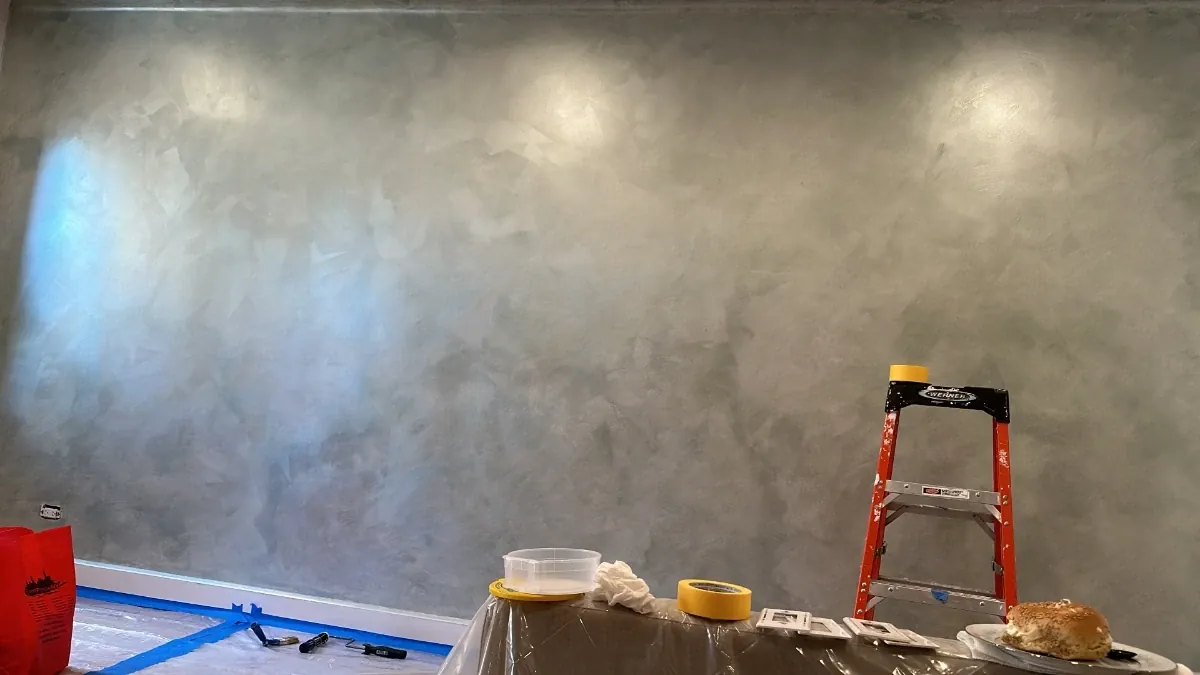
Gray Venetian plaster, hand-troweled, with a tree mural being painted over it.
Lime plaster walls are far older. The National Park Service's Preservation Brief on historic flat plaster explains that North American plasterers used lime plaster (lime, sand, animal hair and water) until the end of the 19th century; gypsum came into use around 1900 and was eventually favored because it set faster. Some plasterers added marble dust to the lime finish coat and polished it with a steel trowel, the same idea as Venetian plaster. So a prewar NYC apartment built after about 1900 most likely has gypsum plaster, or gypsum and lime together, while an older rowhouse may have true lime plaster; once cured, the Park Service notes, they are hard to tell apart.
Lime plaster makers such as Vasari describe their plasters as breathable and naturally resistant to mold. Vasari says plaster generally doesn't need sealing except in demanding spots such as kitchen backsplashes, and sells a dedicated system for showers. More in what Venetian plaster is and our Venetian plaster cost guide.
Roman clay vs limewash: the real differences
Both are matte and both have movement. Where they part ways:
- Tool and feel. Limewash is brushed on as a thin, translucent layer, so brush strokes turn into clouds. Roman clay is knifed on and sanded between coats, so it feels smoother and looks more solid, closer to plaster.
- The wall underneath. Limewash's flat, cloudy finish forgives an imperfect wall. Roman clay needs a smooth one, so old plaster may need a skim coat first; and it's interior-only, while limewash also goes on exterior brick.
- Cleaning. Sealed Roman clay washes with mild soap; interior limewash doesn't wash at all.
- Color. Roman clay walls can go deep and saturated, and Portola notes that darker colors show much more movement. Limewash stays soft and chalky, because lime takes only a little tint.
- Price. Typically $3–$8 per sq ft for interior limewash in NYC against $8–$18 for Roman clay.
Roman clay vs Venetian plaster
Portola itself compares Roman Clay to Venetian plaster with a subtler, more organic look. The differences:
- Depth and sheen. Roman clay tops out at an ultra-low sheen, or eggshell with its topcoat. Venetian plaster can be burnished from matte to high gloss and has more visible depth.
- Toughness and water. Cured lime plaster is hard, wipes clean when sealed and, with a system rated for it, can even line a shower. Roman clay stays on dry interior walls.
- Repairs. Small chips in Venetian plaster patch with the same tinted plaster; Roman clay touch-ups are harder to hide.
- Cost. Typically $8–$18 per sq ft for Roman clay against $15–$30 for polished Venetian plaster. Both need a smooth, primed wall first.
Venetian plaster vs limewash
Both are lime, used differently. Limewash is a thin lime paint brushed on in two or three coats; Venetian plaster is built up with a trowel in several thin coats, each left to dry, then burnished. Limewash gives a flat, chalky wash of color; Venetian plaster gives depth and, if you want it, shine. Limewash belongs on exterior brick; Venetian plaster is mostly an interior finish, though some marmorinos are rated for exterior walls.
Which should you choose? Four NYC situations
A prewar bedroom with old plaster walls
A typical prewar bedroom has plaster walls under decades of paint, often with hairline cracks and a gentle wave you only see in raking light (see plaster vs drywall in prewar apartments).
- For a soft, quick change, choose limewash. A very flat, cloudy finish doesn't spotlight every wave the way a sheen does. Romabio rates Velatura for drywall, so on painted plaster we test a patch first. Bedroom walls in limewash (about 400 sq ft of wall) typically cost $1,200–$3,200 in NYC.
- For plaster depth, choose Venetian plaster or Roman clay, and budget for plaster repair and a skim coat first, because both need a flat, smooth wall. Prep before plastering typically adds $1.50–$6 per sq ft.
In a building from before 1978, the EPA's Renovation, Repair and Painting rule requires paid work that disturbs more than 6 sq ft of paint per room to be done by a certified firm using lead-safe practices. Sanding old paint before a skim coat counts.
A powder room
No shower means all three can work, but a powder room gets wet hands, sink splashes and constant touching.
- Venetian plaster is the classic choice: lime handles humidity, and sealed or waxed it wipes clean. A powder room in Venetian plaster (about 200–250 sq ft of wall) typically costs $3,000–$7,500 in NYC; cuts around the vanity and mirror keep small rooms at the high end per sq ft.
- Roman clay works with its topcoat, as long as the wall right behind the faucet gets stone or tile.
- Limewash is the weakest choice around a sink, because it can't be washed.
A brick house in Queens or on Long Island
- Unpainted brick: limewash. Classico soaks into absorbent brick with no primer, lets moisture escape, which matters through freeze–thaw winters, and ages into a softer patina rather than peeling. Exterior limewash typically costs $4–$10 per sq ft in NYC, plus access equipment on taller walls; repointing is quoted separately. It's a warm-season job: Romabio wants air between 55°F and 90°F, no showers during the 12 hours it takes to dry, and no overnight frost.
- Already-painted brick: mineral paint. Limewash is made for bare masonry. Romabio's route for painted brick is Masonry Flat, a breathable potassium-silicate paint, over MicroGrip primer: a solid, flat painted look rather than a wash.
On pre-1978 houses, the RRP rule applies once paid work disturbs more than 20 sq ft of exterior paint. If the house is an individual landmark or in a historic district, the LPC permit guidebook says staff cannot approve painting unpainted masonry that was never historically painted, or coatings sold as "waterproof." More on brick and stucco in exterior painting.
A rental apartment
- Tenants: get the landlord's OK in writing first. None of these finishes peels off like removable wallpaper, so agree who pays for priming and repainting at move-out. One limewashed wall is the cheapest experiment: a 100–150 sq ft accent wall typically runs $500–$1,200.
- Landlords: for turnover units, washable paint is still the practical choice, because interior limewash and unsealed Roman clay can't be scrubbed between tenants. Save plaster for a lobby, a hallway or a feature wall you'll maintain.
In buildings built before 1960 where a child under six lives or spends 10 or more hours a week, NYC's lead law requires owners to use safe work practices whenever more than two square feet of lead-based paint, or paint of unknown lead content, is disturbed (HPD's lead-based paint rules). For a standard rental refresh, see apartment painting.
What limewash, Roman clay and Venetian plaster cost in NYC
Typical job sizes (per-square-foot rates are in the first table):
| Job | Typical NYC range, installed |
|---|---|
| Limewash accent wall (about 100–150 sq ft) | $500–$1,200 |
| Roman clay accent wall (about 100–150 sq ft) | $800–$2,700 |
| Venetian plaster accent wall (about 100–150 sq ft) | $1,500–$4,500 |
| Bedroom walls in limewash (about 400 sq ft of wall) | $1,200–$3,200 |
| Powder room or small room in Venetian plaster (about 200–250 sq ft) | $3,000–$7,500 |
| Metallic, pearlescent or multi-tone plaster | $20–$40 per sq ft |
| Wall prep before plaster (skim coat and primer), if needed | $1.50–$6 per sq ft |
Typical NYC market ranges, reviewed November 2026, not DecoStyle quotes. Coats, primer, wall condition, wet-area sealer, small-area minimums and access move the price; we quote after a free site visit.
Limewash, Roman clay and Venetian plaster in NYC with DecoStyle
We apply Venetian plaster, Roman clay and Romabio limewash across Queens, the rest of NYC, Long Island and Westchester; our decorative painting covers glazes and metallics. Our plaster work includes the soft decorative plaster in the fitting rooms at Anton's Tuxedos in Valhalla, finished while the store stayed open through the 10-day job, and a pink Venetian plaster counter front at Café Renis in Astoria. All three look different in daylight and lamplight, so book a free estimate: we look at your walls, put samples up, and price the finish that suits the room.